Rare Books Special Topic Project: Occult Bookplates

As a book lover, there is nothing more personal than a bookplate. If you’ve ever opened an old book and found a small decorative label pasted inside the front cover, you have discovered bookplates: individualistic signatures of ownership that have been around for hundreds of years. As a rare book collector, discovering an Ex Libris (“from the library of…”) within the cover of a book is always fascinating since they quite often tell a story, while giving some provenance about the book. Within the world of rare books and bookplates, a fascinating niche is bookplates created within the community of the Occult Revival. They can reveal who owned a book, what they believed, and how ideas circulated among occultists whose practices were often kept out of the public eye. This blog post will demonstrate how bookplates commissioned or created by occultists of the time reflected their ideals, and examine how bookplates contained in rare occult books tell a story of a person or place.
Bookplates first appeared in the 15th century as printing helped book numbers grow amongst the public. Early designs were simple, reflecting the noble families and monasteries that owned most books at the time. As literacy expanded and books became more affordable, bookplates evolved. By the 18th and 19th centuries, they were no longer just shields and crests, but oftentimes personal works of art. Owners commissioned artists to design plates that reflected their personality, interests, and aspirations. The Arts & Crafts movement, as well as Art Nouveau all left their mark on bookplate design in the later 19th Century.

This shift in bookplate culture coincided with one of the most interesting moments in occult history: the Victorian and Edwardian Occult Revival. During the late 19th and early 20th centuries, the Western world saw a surge of interest in magic, spiritualism, symbolism, Theosophy, astrology, and hermetic philosophy. The movement attracted some of the era’s most respected artists, writers, and intellectuals. The Hermetic Order of the Golden Dawn included actors, poets, and scholars. The Theosophical Society drew spiritual seekers from around the globe. Later, Aleister Crowley’s organizations, the A∴A∴ and the O.T.O., continued this fascination with ritual and Qabalah. This included Crowley founding The Equinox, which served as both a biannual periodical and the official publishing arm of his magical order, the A∴A∴. It produced books on occult instruction, ritual texts, Thelemic philosophy, and the writings of Crowley’s inner circle. Many of the first edition books produced from The Equinox can be very rare and collectible.
For practitioners in these magical orders, books were essential in developing their practice. They studied grimoires, astrological texts, books on alchemy, and Eastern philosophical texts with the same seriousness a modern researcher brings to scholarly articles. Many occultists expressed themselves through highly symbolic bookplates. These small designs often incorporated esoteric imagery: solar and lunar motifs, Hebrew letters, sigils, angels, mythological figures, or alchemical emblems. When we look at these bookplates today, we’re not just seeing decorative art, but visual symbolism of what was important to the owner of the books.

A fascinating example of occult-era bookplates comes from W. B. Yeats, the Irish poet who was deeply involved with the Hermetic Order of the Golden Dawn. While Yeats didn’t engrave his own designs, he commissioned a striking woodcut bookplate in 1915 from the artist Thomas Sturge Moore, a longtime collaborator in his literary and mystical circles (Currier Museum of Art, n.d.). The plate features imagery that is full of esoteric symbolism and introspection. Below his name writes: the Latin motto “Bonis Omnia Bona” (“To the good, all things are good”), and below that “Je me trouve,” (“I find myself.”) Both expressions very much express Yeats personal and introspective philosophy. The occult imagery depicted on the plate with the women, a wreath similar to the petals of the Rosicrucian flower, and chalices are rich with occult symbolism.


Another major figure in occult bookplate history is Austin Osman Spare, an artist and occultist who was heavily influenced by Art Nouveau. Spare also created bookplates between 1904 and 1945 for clients such as journalist Dennis Bardens, patron Pickford Waller and more. There is actually a highly collectible rare book by Robert Ansell, who curated Spare’s bookplate art into the book The Bookplate Designs of Austin Osman Spare. The 1988 first edition only has 330 in print, making it very hard to come by. Spare’s bookplates radiate with esoteric style: swirling lines, ethereal forms, dreamlike faces, and sigil-like symbols. Spare believed that magic came from the deep mind, and his art reflects that belief. To find a Spare bookplate within a book would be a rare treasure indeed!
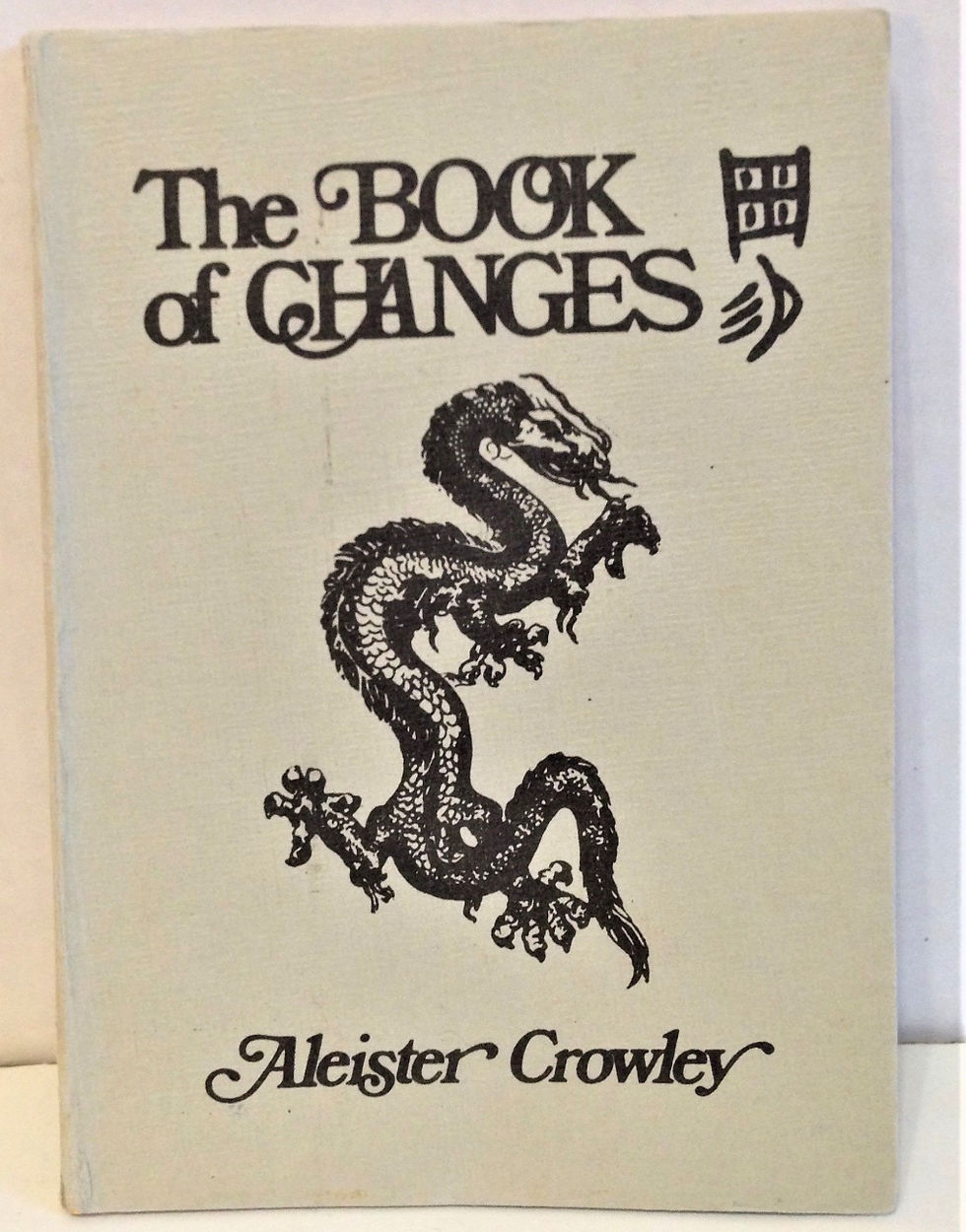
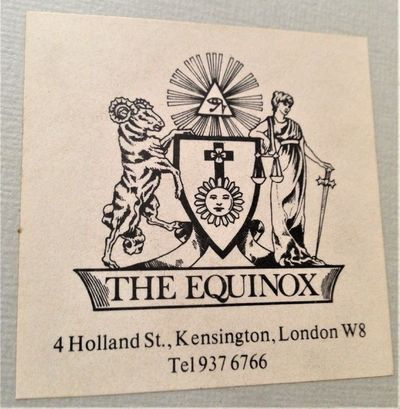
Occult bookplates aren’t just artistic and personal treasures, but play a crucial role in provenance. In rare book collecting, provenance can dramatically increase the value of the book. This is especially true for books tied to influential occult figures. One example is a copy of an I Ching volume with a bookplate from the short lived occult bookshop, the Equinox. The Equinox was an occult book shop opened in London from 1974-1980, created and owned by rock and roll legend Jimmy Page from Led Zeppelin. Page was an avid collector of occult books, especially that of Crowley’s work, hence the store name The Equinox. The shop also acted as a small reprint publisher, creating small batches of reprints of certain Crowley titles. Unfortunately, due to the horrible management of the The Equinox, Page’s dream was short lived and his shop was only open for six years. Books purchased from Page’s shop often carried a small label or bookplate indicating their origin. Since the bookstore no longer exists, these plates now act as historical markers, capturing a time when rock culture, esoteric tradition, and rare book collecting all came together in a very specific cultural moment. A book with a Jimmy Page “Equinox” plate gives a reminder of a place and time that no longer exists.


Another figure whose ownership marks add significant interest is Kenneth Grant, a student of Crowley who went on to found the Typhonian Order. Grant’s writings helped shape modern esoteric literature, especially in Thelemic and post-Thelemic communities. Books from his personal library, which sometimes contain bookplates, stamps, or handwritten notes, are highly sought after. These marks help collectors trace Grant’s interests and influences, showing how Crowley’s ideas traveled into the mid and late 20th century through Grant’s interpretations. As we can tell from the his bookplate contained in The Natural Genesis (1883) by Gerald Massey, Grant had an interest in the origin of myths in relation to ancient Egyptian rituals. Though this bookplate we are able to tell what kind of writings influenced Grant.


Kenneth Anger may be a more contemporary figure in the occult world, but he’s absolutely essential to 20th century esotericism, symbolism, and ritual aesthetics. Best known for his surreal, magically charged films, Anger was also a passionate collector of occult books, especially works connected to Aleister Crowley and Thelema. He left his mark on many of those volumes through distinctive personal bookplates. These plates show up in various occult texts now circulating in rare book markets. In one particular copy of Clouds Without Water(1909), his bookplate appears. The provenance of this copy is particularly notable for its association with Kenneth Anger, who commissioned the custom light-brown cloth slipcase that houses the volume. His ownership is further authenticated by his distinctive brown leatherette bookplate stamped in gilt with his surname and a winged Egyptian scarab, an image traditionally linked to rebirth and spiritual regeneration. Although the title page claims London publication, this first edition of Clouds Without Water (1909) was in fact privately printed in Paris by Renouard, echoing the playful trickery Crowley employed in publishing it under the fictitious priest “Rev. C. Verey.” Passing later through the respected occult bibliographer Clive Harper, this copy’s layered provenance situates it within a lineage of collectors whose interests shaped the modern preservation of esoteric texts. Anger’s personalized additions lend it an especially rich occult provenance.
Occult bookplates are often much harder to find in the rare book world, largely because the books themselves were never widely printed and have long been collectible within small, specialized circles. Instead of ending up in public institutions, many of these volumes have been absorbed into private libraries, where they remain today. While examples do appear at auctions or through niche rare book dealers, they tend to sell quickly, disappearing into yet another private collection.
Occult bookplates remind us that esoteric history isn’t just made of rituals, doctrines, or abstract ideas. They’re the material footprints of people who blended art, magic, literature, and personal symbolism into their everyday lives. These bookplates are much more than decorative touches, but personal signatures, historical evidence, and miniature artworks that hold entire stories within a few square inches of paper.
References
Currier Museum of Art. (n.d.). Bookplate for W. B. Yeats, Thomas Sturge Moore, 1915. Retrieved from https://collections.currier.org
Grant, K. (1972). The Magical Revival. Frederick Muller.
Ledzepnews. (2024, February 22). The history of Jimmy Page’s Equinox occult bookshop - Led Zeppelin News. Led Zeppelin News. https://ledzepnews.com/2024/02/21/the-history-of-jimmy-pages-equinox-occult-bookshop/
Lux Mentis, Booksellers. (n.d.). Occult Ex libris. https://luxmentis.cdn.bibliopolis.com/images/upload/occult-exlibris-smaller.pdf
Massey, G. (1883). The natural genesis (Vols. 1–2). Williams and Norgate.
Pritchard, A. (2015). Thomas Sturge Moore: Art and symbolism in book design.
British Library Publishing.
Raab, R. (Ed.). (1992). The Kenneth Anger papers: Occultism and underground cinema. University Press Archive.
Schuchard, M. (1998). Yeats and the occult tradition. In The Cambridge Companion to W. B. Yeats (pp. 141–165). Cambridge University Press.
Symonds, J., & Grant, K. (Eds.). (1973). The confessions of Aleister Crowley: An autohagiography. Jonathan Cape.
Yorke, G. (1974). Clouds without water. Teitan Press.
Comments